Planning a trip and unsure where to start with Alsace castles? Begin with Haut-Koenigsbourg, Fleckenstein, Lichtenberg and Hohlandsbourg, then add the free-access ruins that line the Vosges.
Alsace is one region within the wider guide to french chateau regions, where each area has its own page.
| Item | Value |
|---|---|
| Castle sites open to visit | About 80 sites |
| Free-access ruins among them | 75 ruins |
| Haut-Koenigsbourg altitude | 757 metres |
| Haut-Koenigsbourg yearly visitors | About 530,000 visitors per year |
| Hohlandsbourg altitude | 620 metres |
| Fleckenstein altitude | 370 metres |
These figures come from Routard’s June 2020 report on medieval Alsace. Visitor numbers and opening arrangements can change, so check the source and each site before you rely on them.
Why Alsace has so many hilltop castles
According to Routard, Alsace holds the highest density of castles in Europe, a legacy of the Holy Roman Empire and the region’s turbulent feudal history. The same report says its fortresses sit above the valleys and the vineyards, which explains why so many views come with a ruin attached. Routard is the source for this claim.
The same report counts about 80 sites open to visit, of which 75 are ruins with free access. The remaining few are staffed castles that, in Routard’s words, are open almost all year, with guided visits, games and costumed shows (Routard, June 2020).
For a fuller inventory, Wikipedia’s list of castles in Alsace is organised by the region’s two departments, Bas-Rhin and Haut-Rhin. The page was last edited on 8 September 2022, so newer restorations may not appear there.
Alsace castles to start with
Five sites come up again and again in guides, and together they show the range: a rebuilt imperial fortress, a sandstone eagle’s nest, a theatrical hill castle, a Habsburg lookout and a falconry centre.
Haut-Koenigsbourg
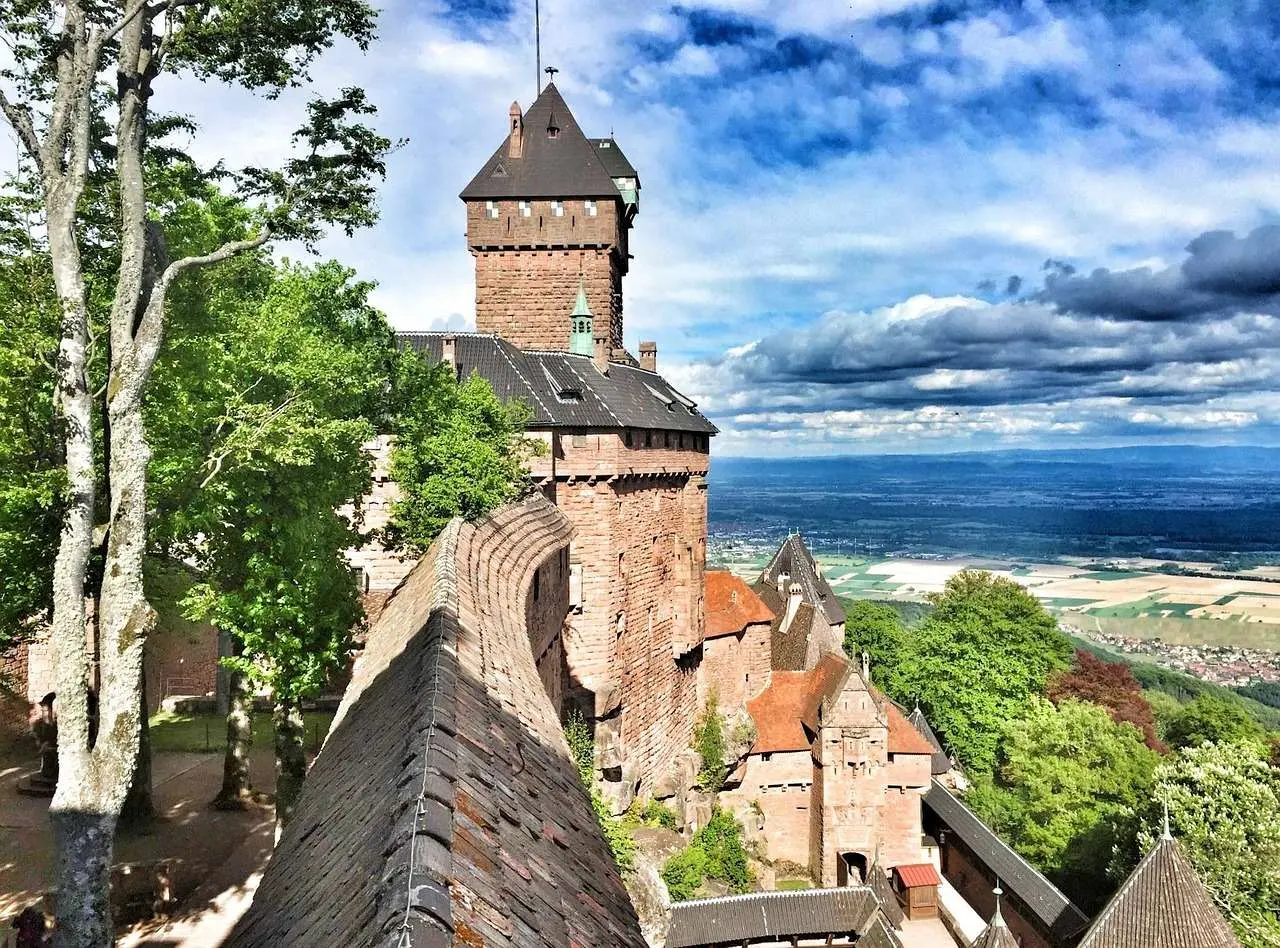
This is the best known of the group, and Routard puts its attendance at about 530,000 visitors a year, just behind Chambord in the Loire Valley. It stands at 757 metres, with a belvedere over the plain, the Vosges and the Black Forest.
The same report notes that illustrator John Howe, who worked on Peter Jackson’s Lord of the Rings films, drew on it for the citadel of Minas Tirith.
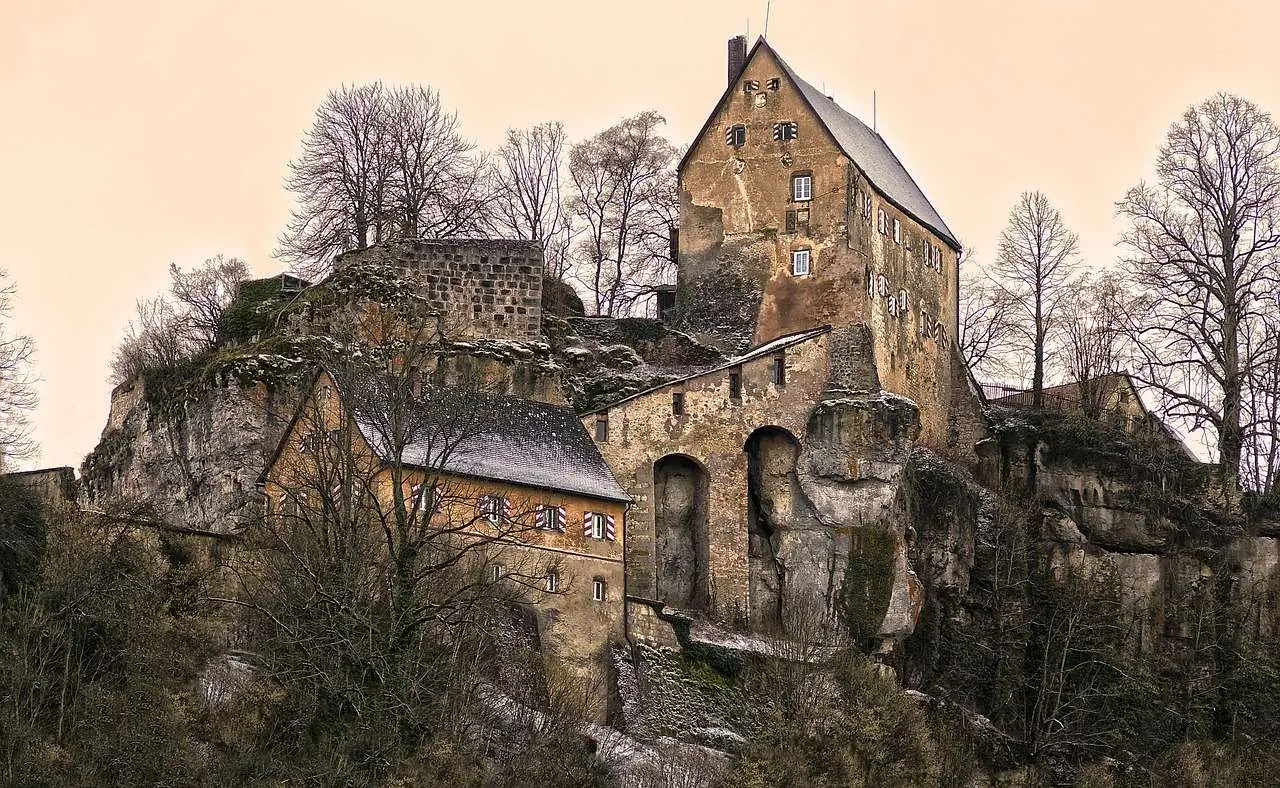
Fleckenstein
Perched on a sandstone rock at 370 metres, Fleckenstein earns its nickname “eagle’s nest”, and some of its rooms are carved directly into the rock (Routard). It offers two playful visit formats for families: “Le Château des défis” and “Visite du P’tit Fleck”.
Lichtenberg
Routard says the Lichtenberg family built this castle in 1206, and that its panorama over the northern Vosges is seen from 414 metres (Routard). Wikipedia’s list adds that it was reduced to ruins through artillery fire in 1870 (Wikipedia).
Hohlandsbourg
Rudolf of Habsburg raised Hohlandsbourg in 1279 to watch over Colmar, and it stands at 620 metres (Routard). Its setting above the vineyards makes it an easy add-on to a wine-country day.
Kintzheim and its eagles
At Kintzheim the main draw is the Volerie des Aigles, a birds-of-prey centre installed in the castle walls since 1968. Routard says it keeps about forty birds from around the world, including eagles, vultures and owls (Routard).
Following the Alsace Castle Route from north to south
The regional tourist board promotes the Alsace Castle Route, which pairs castles with ramparts and small towns. Visit Alsace lists the stops from north to south, so you can use it as a checklist.
- Northern stops: Wissembourg, Fleckenstein, Wasenbourg, Lichtenberg, La Petite Pierre and Haut-Barr.
- Middle stops: Westhoffen, Pierre-Percée, Wangenbourg, Nideck, Wangen, Wasselonne, Obernai, Kagenfels, Birkenfels, Châtenois, Ortenbourg, Ramstein and Kintzheim.
- Southern stops: Haut-Koenigsbourg, Hohlandsbourg, Ferrette and Landskron.
The board describes the route as exploring castles, but also ramparts and towns, and the people who bring them to life. That makes it a sensible frame for a slow drive rather than a single-castle day (Visit Alsace).
How the ruins came to be
Most of these sites are ruins, and Routard’s castle feature says they are either restored or in ruins and still shape the landscape. Wikipedia’s list records the causes for several of them:
- Nideck: destroyed by fire in 1636.
- Landskron: rebuilt by Vauban after 1665.
- Lichtenberg: ruined by artillery fire in 1870.
- Haut-Koenigsbourg: abandoned after the Thirty Years’ War, then restored after 1900 under the direction of Wilhelm II of Germany.
The pattern is useful on the ground. A castle listed as reconstructed usually has rooms to walk through, while a ruin is mostly walls, towers and views.
Planning a visit to Alsace castles
Start by deciding whether you want a staffed castle or an open-air ruin, since the experience differs. Staffed sites keep their own opening arrangements, so confirm them with the site or its tourist office first.
- Pick one big castle per day and pair it with one or two nearby ruins.
- Wear sturdy shoes: many ruins sit on steep forest paths.
- Travelling with children? Look at the families’ options at Fleckenstein, Kintzheim and Haut-Koenigsbourg.
- Use the route list above to string together stops that sit near each other.
For a contrast with these Vosges ruins, the guide to normandy chateaux and castles covers a very different region. A trip further south can continue with provence chateaux.
Frequently asked questions
Which Alsace castle is the busiest?
Show answer
Haut-Koenigsbourg, according to Routard, which ranks it directly behind Chambord for attendance (Routard).
Can you see the ruins without paying?
Show answer
Most can: Routard’s June 2020 report describes the large majority of open sites as free-access ruins, while staffed castles run their own visits (Routard). Check each site before you set out.
Where can you find a complete list of castles?
Show answer
The French Chateau site lists 169 entries for Alsace, including ruins and lost chateaux (French Chateau). Wikipedia’s list is split between Bas-Rhin and Haut-Rhin (Wikipedia).
Is Haut-Koenigsbourg an original medieval building?
Show answer
Not entirely. Wikipedia’s list marks it as reconstructed and ties the rebuilding to work directed by Wilhelm II after 1900 (Wikipedia).