Planning a trip to the Cathar castles of Occitanie? Start with the eight royal fortresses of Languedoc, which UNESCO inscribed in July 2026, and plan on walking steep, uneven paths to reach most of them.
This guide is part of our series on french chateau regions, and it covers the history, the sites and the practical side of the visit.
| Item | Value |
|---|---|
| UNESCO inscription of the eight Royal Fortresses of Languedoc | July 2026 |
| Frontier treaty behind the fortress network | Treaty of Corbeil, 1258 |
| Cathar Trail | GR®367, from the Mediterranean to the Pyrenees |
| Suggested fortress route | 3-5 days, 331 km / 206 miles |
| Altitude of Peyrepertuse | 800 metres |
Figures come from Visit Occitanie and France.fr. They can change, so check the source before you rely on them.
What are the Cathar castles, really?
The phrase Cathar castles is a popular shorthand, yet Aude Tourisme notes that some people apply it incorrectly, while others prefer the name “Citadels of Vertigo” coined by Michel Roquebert. The name hints at the Cathars, a dissident religious movement, but the story of the stone is more layered.
According to Visit Occitanie, the fortresses were built or extensively remodelled during the 13th century by the French Crown. Their purpose was to secure the border with the Kingdom of Aragon.
The same page states that eight of them were inscribed on the UNESCO World Heritage List in July 2026. They stand in the Corbières, the Montagne Noire and the Pyrenean foothills, across the Aude and Ariège departments.
How the crusade and the Crown shaped the fortresses
The Albigensian Crusade is the backdrop. France.fr says the Pope launched a crusade in 1208 against heretics who had found safe haven in Languedoc.
After the turmoil, the Crown took over. Visit Occitanie describes a defensive network protecting the frontier set by the Treaty of Corbeil in 1258, with watchtowers, crenellated ramparts and a long-distance visual signalling system.
Montségur keeps the strongest link with Cathar memory. France.fr calls it a symbol of resistance and the last refuge of the Cathars, who were persecuted for years by the Pope’s army.
A separate France.fr guide, the quick essential guide, describes Aguilar, Peyrepertuse, Puilaurens, Quéribus and Termes as the “Five Sons” that protected Carcassonne.
The eight royal fortresses at a glance
Each site has its own character, from a walled city to a ruin that seems to hang in the air. Here is what the tourism sources say about each one.
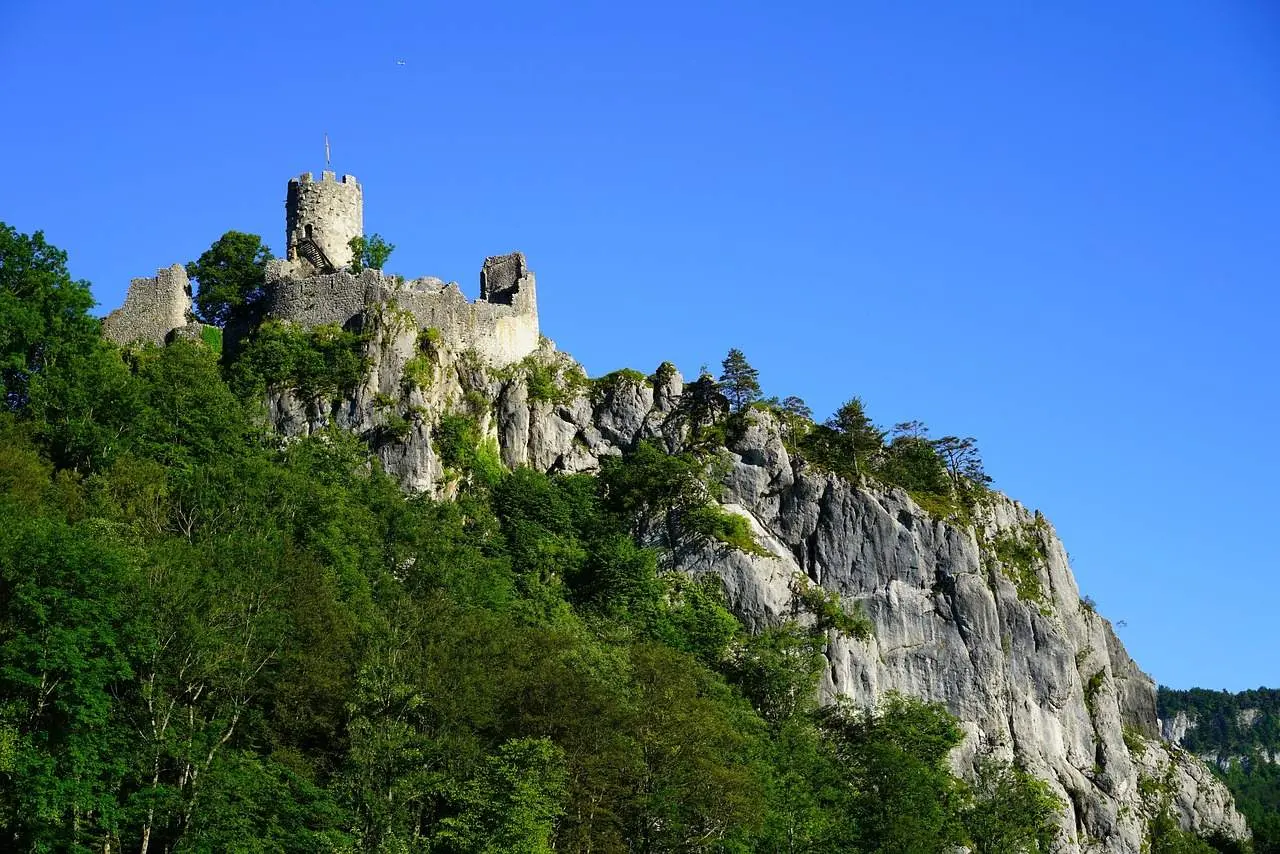
- Carcassonne: the walled city occupies a central place within the group, per Visit Occitanie.
- Lastours: four castles (Cabaret, Surdespine, Quertinheux and Tour Régine) overlook a river from a height of over 300m, according to France.fr.
- Termes: set above the Termenet Gorge.
- Aguilar: perched above the vineyards around Tuchan.
- Quéribus: the last Cathar stronghold, on a rocky peak near Cucugnan.
- Peyrepertuse: the largest of the Royal Fortresses, per the same Visit Occitanie itinerary.
- Puilaurens: known for its zigzag defensive staircase.
- Montségur: in Ariège, the symbolic heart of Cathar history and legend.
Two altitudes show how high these sites sit. France.fr places Peyrepertuse at 800 metres, covering the same area as the citadel of Carcassonne, and Montségur at 1,200 metres.
Planning a route and walking the Cathar Trail
Visit Occitanie proposes a fortress route of 3-5 days and 331 km / 206 miles. Its outline, from the Visit Occitanie itinerary, runs like this:
- First day: Carcassonne, then the Four Castles of Lastours above the Cabardès valley.
- Second day: Termes Castle, then Aguilar Castle, with Corbières and Fitou wine tastings on the way.
- Third day: Quéribus near Cucugnan, then nearby Peyrepertuse.
- Fourth day: Puilaurens, then Montségur in Ariège.
On foot, the Cathar Trail (GR®367) is a long-distance route from the Mediterranean coast to the Pyrenees. It passes beneath Aguilar, Quéribus, Peyrepertuse, Puilaurens and Montségur, says Visit Occitanie, and it can also be done on horseback.
Other guides quote different trail lengths, so confirm the stages with a local tourist office before you set out.
Practical tips for visiting
Visit Occitanie says a visit means rocky paths, steep slopes and winding mountain trails. Keep these points in mind:
- Wear sturdy walking shoes.
- In summer, carry plenty of water and wear a hat.
- Expect steep trails, though they are suitable for most walkers.
- Leave pushchairs and strollers behind, as they are not recommended.
Peyrepertuse also hosts what France.fr calls the largest medieval festival in the South of France each year, with troupes performing in the castle and a reconstructed medieval village.
If you want a contrast to these mountain strongholds, the loire valley chateaux make a natural next read. Short trips from the capital are covered in our guide to chateaux near paris.
Frequently asked questions
Are the Cathar castles actually Cathar?
Show answer
Only partly. Several sites were strongholds in the crusade era, but the tourism boards stress that the Crown later rebuilt or reworked them as frontier defences, so the nickname simplifies a longer story.
Which site suits a short visit?
Show answer
France.fr suggests heading straight to Lastours if you are pressed for time, since the village offers several castles in one stop, as described in its quick guide.
Do I need to be a serious hiker?
Show answer
No. Visit Occitanie describes the trails as steep in places but manageable for most walkers, and Carcassonne itself is an urban visit with no mountain approach.
Can the Cathar Trail be done by something other than walking?
Show answer
Yes. The tourism board describes the route as one to walk or ride, so horseback is an option alongside hiking.